
HEP software has more benefits than just making things easier. When used correctly, it helps patients stick to their treatment, improves outcomes, and helps clinics grow in a way that lasts by providing care outside of the clinic. This article talks about how HEP software works in real-life clinical settings, why old methods don’t work as well, and how new tools help patients and therapists between visits.
Benefits of HEP Software
When therapy goes beyond scheduled appointments, the benefits of HEP software become clear. In-clinic care sets the course, but patients’ actions at home are what really matter for recovery. Digital HEP tools help patients understand things better during that time when they are not being watched by giving them steady guidance instead of one-time instructions.
This means that patients will be less confused and more sure of themselves. Exercises look exactly like they should, which lowers the chance of doing them wrong or missing sessions. The benefit for clinics is that they can keep things going. Therapists stay aware of how well their patients are doing without having to do more work. Over time, this steady support leads to better results, more trust from patients, and more predictable care delivery.
The following list shows how HEP software can help in both clinical and operational areas.
| Area of Care | How HEP Software Helps |
| Patient understanding | Provides clear visual guidance instead of written descriptions |
| Exercise consistency | Encourages regular completion through structured schedules |
| Therapist oversight | Offers visibility into patient progress between visits |
| Treatment efficiency | Reduces time spent re-explaining exercises |
| Long-term outcomes | Supports sustained recovery through continued engagement |
By addressing the gaps left by traditional methods, HEP software helps clinics deliver care that remains effective well beyond the treatment room.
What Is HEP in Physical Therapy? Meaning, Medical Abbreviation, and Real-World Use
HEP is short for “home exercise program.” In medical documents, the abbreviation “hep” stands for a set of therapeutic exercises that a doctor has prescribed to help someone recover outside of the clinic. Depending on how the documentation is written, you might also see it called hep pt, hep therapy, or physical therapy hep.
In real life, an hep home exercise program helps patients stay on track with their treatment goals between visits. It helps with neuromuscular control, builds strength over time, and helps with mobility. Without a regular HEP, progress often stops, especially for people who have long-term or post-surgical conditions.
Why HEP Software Is Becoming Standard Care
Physical therapy is shifting toward care models that prioritize consistency over intensity. As patient volumes increase and visit limits tighten, clinics can no longer rely solely on in-person supervision to drive outcomes. The ability to support patients between visits is quickly becoming a standard expectation rather than a bonus.
HEP software aligns with this shift by ensuring that progress continues even when patients are outside the clinic. Clinics that adopt structured digital tools are better positioned to manage caseloads, reduce regressions, and maintain outcomes under modern reimbursement and scheduling pressures.
In 2026 and beyond, home exercise delivery is no longer optional infrastructure. It’s a core part of effective care.
Why Paper Handouts and PDFs Fail Patients and Clinicians
Instructions on paper assume that everything will go perfectly. Patients need to be able to remember demonstrations, read diagrams correctly, and control the intensity of their treatment without any help. Uncertainty actually comes in very quickly.
Paper programs make it hard for doctors to see everything. There is no way to know how well or how often instructions are followed once they leave the clinic. Changes are based on what the patient remembers, not what they see. This disconnect makes recovery take longer and results vary over time.
How HEP Software Improves Patient Outcomes Between Visits
Once patients leave the clinic, progress depends on how well exercises carry over into daily routines. HEP software supports this transition by reinforcing structure, accuracy, and consistency during the time when supervision is no longer present.
| Between-Visit Factor | Effect on Patient Outcomes |
| Visual exercise guidance | Reduces incorrect movement patterns |
| Structured scheduling | Encourages steady participation |
| Timely reminders | Limits missed exercise sessions |
| Progress visibility | Helps therapists adjust care earlier |
| Consistent reinforcement | Supports gradual, sustainable improvement |
HEP software helps make sure that each clinic visit builds on real progress instead of repeating what happened before by making things better between appointments.
Clinical Impact on Physical Therapists and Clinics
HEP software changes how care is given in the clinic. Physical therapists can see how their patients act between visits more clearly without having to explain things over and over or follow up by hand. This change lets doctors focus on assessment, progression, and skilled treatment instead of just reinforcement.
The clinical and operational impact becomes easier to see when comparing daily practice before and after adopting structured digital HEP tools.
| Clinical Area | Impact on Therapists and Clinics |
| Treatment progression | Exercises advance more smoothly due to consistent follow-through |
| Time management | Less time spent re-teaching home exercises |
| Clinical decision-making | Adjustments based on observed patterns, not assumptions |
| Patient communication | Fewer misunderstandings around expectations |
| Care consistency | More uniform delivery across providers |
These changes support better clinical judgment, improved efficiency, and a care model that scales without compromising quality.
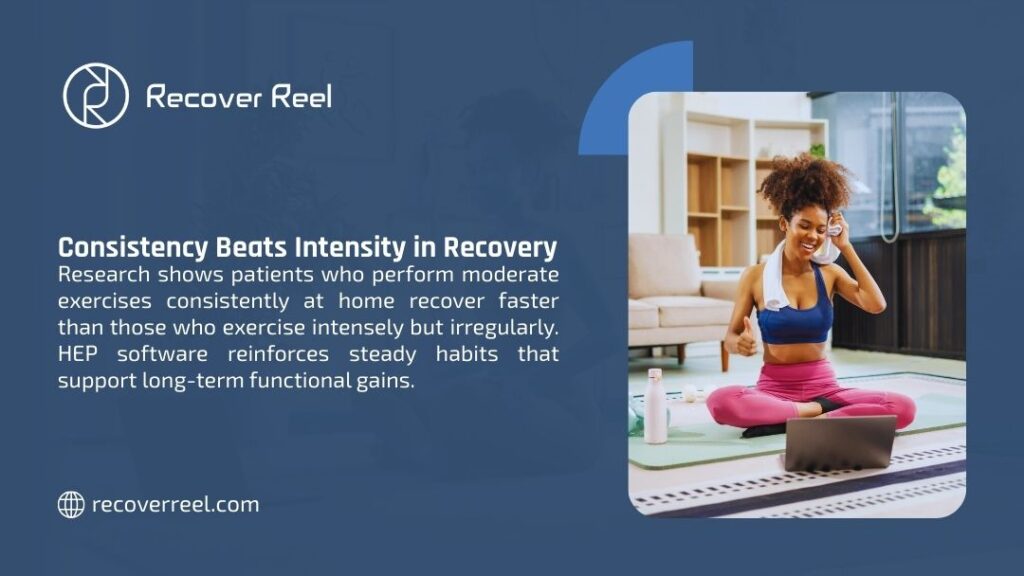
How HEP Software Improves Patient Adherence
Adherence improves when patients understand expectations and feel supported. HEP software addresses both factors. Visual guidance reduces fear of incorrect movement, while reminders help patients maintain consistency.
Patients who follow structured programs are more likely to complete their physical therapy hep plans and less likely to disengage early. This sustained participation explains why digital tools consistently outperform manual approaches.
Impact of HEP Software on Patient Outcomes
Clinical outcomes reflect how well patients carry out exercises over time. The contrast becomes evident when comparing traditional delivery with structured digital support.
Before reviewing the comparison, it is important to note that outcomes depend on accuracy and frequency rather than exercise selection alone.
| Outcome Area | Traditional HEP | HEP Software |
| Exercise accuracy | Inconsistent | Guided |
| Symptom setbacks | More frequent | Reduced |
| Functional gains | Slower | Steadier |
| Discharge readiness | Variable | More predictable |
After adoption, many clinics report smoother progressions and fewer regressions tied to missed exercises.
Workflow Benefits for Physical Therapists and Clinics
HEP software reshapes daily workflow by reducing repetition and improving clarity. Therapists no longer need to reteach the same exercises each visit, and follow-ups become more efficient.
The comparison below highlights how digital delivery changes clinic operations.
| Workflow Element | Manual HEP | HEP Software |
| Program updates | Time-intensive | Quick |
| Patient feedback | Verbal recall | Data-supported |
| Exercise education | Repeated often | Reinforced digitally |
| Care continuity | Limited | Ongoing |
These efficiencies allow clinics to focus on higher-value care rather than administrative repetition.
HEP Software vs Traditional Home Exercise Programs
| Feature | Traditional Programs | HEP Software |
| Instruction clarity | Text-based | Visual |
| Patient accountability | Minimal | Built-in |
| Adaptability | Limited | Flexible |
| Engagement | Passive | Active |
This contrast explains why many clinics move away from paper-based systems once digital options become available.
How Often Should Patients Do Physical Therapy Exercises at Home
The frequency of home exercises varies from one patient to another. Factors such as injury severity, pain response, and overall conditioning all influence how often movement should occur. In the early stages of care, lighter exercises may appear more frequently to maintain mobility without overloading tissue. As recovery progresses, frequency may decrease while intensity increases.
One challenge patients face involves uncertainty. Without clear guidance, some do too much while others hesitate to do enough. HEP software addresses this by presenting expectations in a clear, organized format. Schedules outline when exercises should happen, while progress markers signal when it is appropriate to advance. This clarity helps patients follow their physical therapy health routine with greater confidence and fewer setbacks.
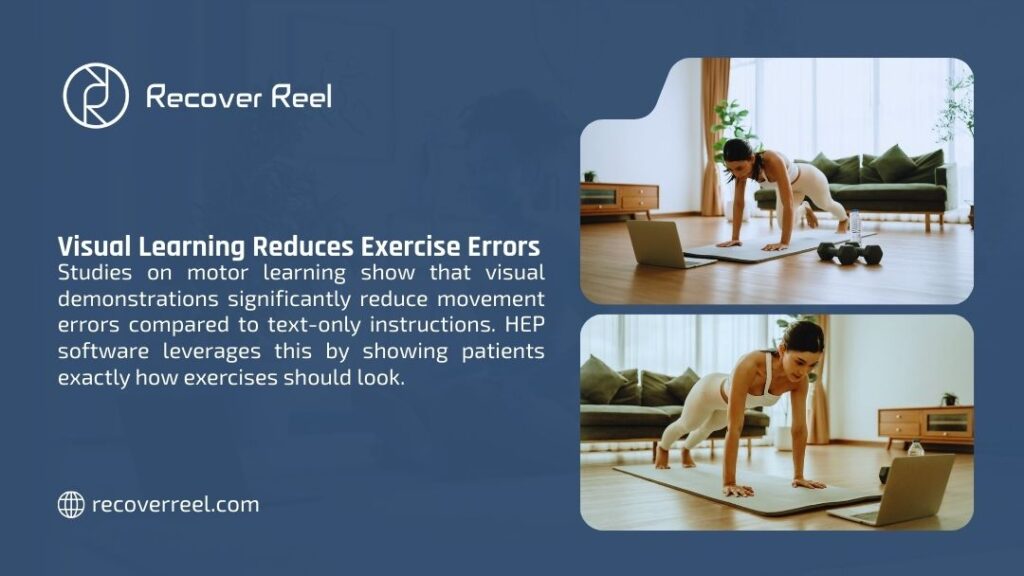
Patient Engagement Through Technology
Engagement grows when patients understand both the purpose and execution of their exercises. Digital tools support this by replacing abstract instructions with concrete demonstrations. Seeing how movements should look removes doubt and reduces fear of doing something incorrectly.
Technology also reinforces consistency. Reminders prompt action at appropriate times, while visible progress encourages follow-through. Patients who feel supported rather than monitored tend to stay involved longer. That sustained engagement often extends beyond formal therapy, helping patients carry healthier movement habits into daily life and maintain improvements well after discharge.
Data Tracking and Progress Monitoring
Tracking progress informs clinical decisions. Digital HEP platforms allow therapists to review adherence trends and adjust programs accordingly.
| Tracking Element | Manual Methods | Digital HEP |
| Completion visibility | None | Available |
| Trend analysis | Not possible | Built-in |
| Adjustment timing | Delayed | Timely |
After reviewing progress data, clinicians can modify programs with greater precision.
Compliance, Privacy, and Security in Digital HEP Tools
Digital HEP tools operate at the intersection of healthcare and technology, which places clear responsibility on how patient information is handled. Beyond basic functionality, effective platforms must support confidentiality while remaining practical for daily clinical use.
Strong systems separate patient data access by role, ensuring that only authorized clinicians can view or modify treatment information. Secure login protocols, encrypted data storage, and controlled sharing permissions all contribute to reducing exposure risks.
These safeguards are not simply technical requirements; they influence patient confidence. When patients trust the system, they are more willing to engage consistently with their home exercise program.
Privacy also plays a role in continuity of care. Tools that maintain compliance without interrupting usability allow therapists to stay connected with patients while respecting boundaries. This balance helps clinics meet regulatory expectations without creating friction for either staff or patients.
What to Look for in Effective HEP Software
Not all HEP software supports clinical practice in the same way. The most effective platforms prioritize simplicity without sacrificing depth. Therapists need systems that adapt to patient needs rather than forcing care to fit rigid templates.
Flexibility matters. Programs should evolve as symptoms change, without requiring extensive setup time. Visual clarity, intuitive navigation, and straightforward program updates reduce cognitive load for both clinicians and patients. Over time, this ease of use encourages consistent adoption across the clinic rather than limited use by a few providers.
Clinics often evaluate effectiveness by looking at real-world performance. For example, this case study showing how a physical therapist improved patient compliance through structured digital delivery offers insight into what practical success looks like.
Cost transparency also influences long-term viability. Systems that scale based on active patient use allow clinics to manage growth without unexpected expenses, making pricing clarity an important part of the decision process.
Choosing the right platform ultimately depends on how well it supports daily practice while maintaining patient trust and operational stability.
Patient Adherence, Behavior, and Long-Term Recovery
Long-term recovery depends on behavior more than intensity. Patients who develop consistent movement habits maintain gains long after therapy ends. Before reviewing the comparison, consider how sustained engagement influences outcomes months after discharge.
| Factor | Low Adherence | High Adherence |
| Functional improvement | Limited | Sustained |
| Re-injury risk | Higher | Lower |
| Confidence | Reduced | Improved |
| Quality of life | Variable | Higher |
After recovery, adherence-driven habits often carry forward into daily life.
Paper HEPs vs Digital HEP Software
| Aspect | Paper HEP | Digital HEP |
| Instruction durability | Short-term | Ongoing |
| Patient recall | Inconsistent | Reinforced |
| Therapist insight | Minimal | Continuous |
This difference explains why clinics reassess their approach to home exercise delivery.
Clinical Outcomes With and Without HEP Software
| Metric | Without Software | With Software |
| Exercise compliance | Lower | Higher |
| Recovery timelines | Longer | Shorter |
| Patient satisfaction | Moderate | Strong |
These outcome differences influence both care quality and clinic performance, reinforcing the value of digital support systems.

Closing Perspective and Next Steps
The benefits of HEP software reflect a broader shift in physical therapy. Care no longer ends at the clinic door. It continues through daily movement, guidance, and feedback.
Clinics ready to extend care beyond visits and support patients where recovery actually happens can explore how modern platforms approach home exercise delivery. Learning more about the team and philosophy behind this approach offers helpful context.
For clinics considering next steps or seeking answers about implementation, reaching out directly can provide clarity. When consistency improves, outcomes follow. And that’s exactly where modern physical therapy is headed.