
HEP software refers to digital platforms that allow physical therapists to design, deliver, and monitor home exercise programs with far more consistency than paper handouts or static PDFs. These systems support patient engagement, improve adherence, and help clinics maintain continuity of care beyond the clinic walls.
This article explains what HEP software is and how it supports physical therapists in delivering structured home exercise programs beyond the clinic. It aims to help clinics understand its role in improving adherence, patient engagement, and continuity of care.
What is HEP software?
In physical therapy and rehabilitation settings, HEP software describes medical software programs designed to create, distribute, and track a home exercise program for patients outside the clinic. HEP stands for home exercise program, a core component of outpatient rehab, occupational therapy, and physiotherapy at home.
Traditionally, therapists relied on printed sheets or generic physical therapy home exercise program handouts in PDF form. While familiar, those tools lacked accountability and feedback. HEP software replaced that gap by offering structured exercise plans, guided physical therapy exercises, and progress visibility for both clinicians and patients.
From a clinical standpoint, HEP software is a patient education platform that connects exercise therapy prescribed in the clinic with real-world execution at home. For physical therapists, it becomes a digital extension of care. For patients, it acts as a clear roadmap for rehab exercises, without guesswork.
Why HEP software matters in physical therapy
Home exercise adherence has always been the weak link in rehabilitation. Multiple studies show that adherence to home exercise programs often falls below 50 percent, particularly when instructions rely on static materials or memory alone. According to research, poor adherence directly correlates with slower recovery and lower functional outcomes.
This is where HEP software changes the equation. By combining exercise videos, scheduling prompts, and structured exercise plans, these platforms help patients follow through with physical therapy exercises at home. That consistency supports better outcomes, reduces unnecessary visits, and improves patient engagement.
For clinics, the value goes beyond outcomes. Digital HEP platforms support patient care management systems by documenting activity, reinforcing therapist instructions, and improving long-term retention. In a competitive outpatient therapy environment, continuity matters, and HEP software plays a quiet but critical role.
How home exercise program software works in practice
At its core, home exercise program software functions as a centralized exercise software system. Therapists create an HEP program using an exercise library or custom video tools, assign it to a patient, and track progress remotely. Patients access exercises through a web portal or mobile app and follow a clear exercise plan tailored to their condition.
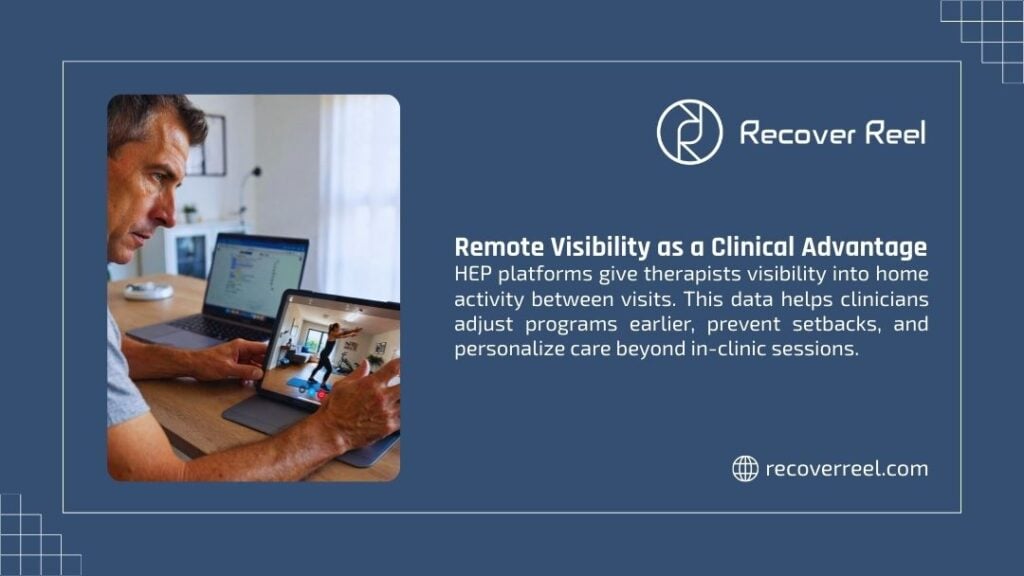
The difference between digital platforms and paper-based systems becomes obvious once tracking enters the picture. With HEP software, therapists see whether exercises were completed, how often, and sometimes how patients report pain or difficulty. That feedback loop strengthens clinical decision-making.
The table below illustrates how HEP software compares to traditional home exercise delivery.
| Aspect | Digital HEP Software | Traditional Paper Handouts |
| Patient access | Mobile or web-based | Printed sheets |
| Exercise clarity | Video-guided therapy exercises | Static illustrations |
| Progress tracking | Yes | No |
| Updates | Instant | Requires reprinting |
| Patient engagement | High | Often inconsistent |
This contrast explains why more clinics now view HEP software as essential outpatient rehab software rather than an optional add-on.
HEP Software vs Exercise Libraries
Here’s the thing. Not all tools used for home exercises serve the same purpose. While both HEP software and exercise libraries support physical therapy exercises, the way they impact patient care and follow-through is very different.
| Aspect | HEP Software | Exercise Libraries |
| Primary focus | Full home exercise program management | Standalone exercise demonstrations |
| Level of personalization | High, with patient-specific exercise plans | Limited to generic selections |
| Patient guidance | Structured schedules and instructions | Minimal context beyond the exercise |
| Progress visibility | Tracks adherence and completion | No built-in tracking |
| Communication support | Often includes secure messaging | Not typically available |
| Role in patient care | Ongoing support beyond visits | One-time reference material |
That difference matters. HEP software supports continuity, accountability, and patient engagement, while exercise libraries mainly act as reference tools rather than complete home exercise solutions.
Core features found in modern HEP platforms
Most modern HEP platforms share a set of foundational capabilities that support both clinical efficiency and patient follow-through. While implementation varies, these features define what effective home exercise program software looks like in practice.
| Core Feature | What It Supports in Clinical Care |
| Exercise program builder | Allows therapists to create structured home exercise plans with specific sets, repetitions, and progression notes |
| Video-based exercise delivery | Helps patients understand physical therapy exercises through visual demonstration rather than written instruction alone |
| Patient access portal or app | Gives patients a single place to view, review, and follow their assigned home exercise program |
| Adherence and activity tracking | Enables therapists to see whether exercises were completed and identify gaps in compliance |
| Program updates and adjustments | Allows clinicians to modify exercises as recovery progresses without restarting the program |
| Secure communication tools | Supports clarification and feedback while maintaining patient privacy standards |
| Data storage and documentation | Keeps exercise history and notes organized for continuity of care and record accuracy |
These features work together to turn a home exercise program from a static instruction sheet into an active extension of in-clinic physical therapy, improving clarity, accountability, and patient engagement over time.

Common use cases for HEP software
HEP software supports a wide range of clinical and patient-led scenarios where consistent guidance and follow-through matter more than in-person frequency. These use cases reflect how physical therapy and rehabilitation now extend beyond the clinic setting.
| Use case | How HEP software supports it |
| Post-injury rehabilitation | Delivers structured rehab exercises with clear instructions, helping patients follow recovery plans between visits |
| Post-surgical recovery | Guides patients through staged exercise plans while allowing therapists to adjust programs as healing progresses |
| Chronic pain management | Supports long-term exercise therapy with repeatable routines and progress awareness |
| Outpatient physical therapy | Reinforces in-clinic treatment through physical therapy exercises at home |
| Physiotherapy at home | Enables patients to complete prescribed exercises without frequent clinic visits |
| Remote or hybrid care models | Maintains continuity when care includes both in-person and online physiotherapy sessions |
| Patient education support | Improves understanding of therapy exercises through visual and written guidance |
| Preventive and maintenance care | Encourages ongoing movement and strength work after discharge |
These scenarios show why HEP software has become a practical extension of patient care, supporting both short-term recovery and long-term functional improvement without adding unnecessary clinical burden.
Outcomes, compliance, and patient engagement
Here’s the thing. Clinics rarely struggle with prescribing exercises. They struggle with follow-through. Published research show that digital home exercise programs significantly improved adherence compared to paper-based methods.
Better adherence leads to better outcomes, but it also improves patient perception. When patients understand their exercise plan and see progress, engagement rises. That engagement reduces dropout rates and strengthens trust.
Several clinics document these effects in real-world scenarios. One physical therapist shared how structured digital programs led to measurable adherence gains, documented in this case study on improved patient compliance through Recover Reel, where consistent use translated into sustained patient retention.
Choosing the right HEP software for your clinic
Selecting HEP software requires more than checking feature boxes. Clinics must consider patient demographics, staff workflows, and how exercise programs integrate into existing patient care software. Ease of use matters as much as depth of functionality.
Cost structure also plays a role. Some platforms charge per provider, others per active patient. Understanding pricing transparency helps clinics avoid surprises, which is why reviewing available plans before committing remains critical. Clinics evaluating cost models often review the pricing structure available through Recover Reel’s pricing to compare value against patient volume.
The right platform aligns with how therapists already practice rather than forcing unnecessary changes.

Adoption challenges and how clinics address them
Digital tools always introduce adjustment periods. Some patients hesitate with new apps, while staff may worry about time investment. Clinics that succeed tend to introduce HEP software gradually, pairing education with simple onboarding.
Clear communication solves most barriers. When patients understand why digital home exercise programs support recovery, adoption improves. Likewise, therapists who see adherence data early tend to embrace the system faster.
Educational resources also help. Many clinics explore guides such as proven methods to improve patient compliance with home exercise programs to refine their approach without overwhelming staff.
Why HEP software has become standard, not optional
What is HEP software? Today is very different from what it was a decade ago. It has shifted from optional convenience to a core clinical tool. As healthcare trends push toward value-based care, patient engagement platforms will continue to shape outcomes.
Clinics that rely solely on printed exercises often struggle with retention and measurable progress. Digital home exercise program platforms address those gaps directly. They offer clarity, accountability, and continuity in a way paper never could.
For practices exploring next steps, understanding the philosophy behind modern platforms helps. Learning how one clinic approached this transition is easier after reviewing the background and mission behind Recover Reel, which outlines why clinician-driven HEP systems gained traction.
Conclusion
The question of why to use HEP software ultimately comes down to one question: how well does your clinic support patients once they leave the building? Digital home exercise programs answer that question with structure, visibility, and consistency.
If your clinic already values outcomes, patient engagement, and long-term trust, then evaluating modern HEP platforms becomes less about trends and more about responsibility. Clinics ready to explore practical next steps often start by reviewing real-world tools, success stories, and support options through direct conversations with HEP software providers.
That’s why many practices begin by booking a demo with Recover Reel to understand whether a digital home exercise platform fits their care model before committing.